35 Print-on-Demand Statistics And Trends You Must Know in 2025

The rise of e-commerce has transformed how people shop, but many businesses still struggle to keep up with demand and manage inventory efficiently. Print-on-demand (POD) has emerged as a game-changer, letting sellers produce products only when customers order them.
This industry has grown rapidly through the 2020s and is bigger than ever in 2025. Businesses and entrepreneurs are tapping into POD to reduce waste, cut costs, and meet consumer demand for personalized products. This article covers essential insights, including:
- Key POD statistics and growth trends
- Top products and categories
- Successful business practices
- E-commerce platform trends
Let’s jump right in!
35 Top Print-On-Demand Statistics And Trends in 2025
The print-on-demand industry continues to grow strongly in 2025, showing clear shifts in products, categories, and consumer behavior. The following points highlight the top statistics and trends you need to know to stay informed and make smart business choices.
General Print-on-Demand Statistics
The print-on-demand industry continues to grow, showing strong numbers across sales, products, and customer interest. Understanding these trends can help you make smarter business decisions. Keep reading the following guides to see the key statistics and insights shaping the market in 2025.
1. The print-on-demand industry is growing at a compound annual growth rate (CAGR) of 26%
The print-on-demand (POD) industry is growing rapidly. In 2024, the global market was valued at $10.2 billion and is expected to reach $103 billion by 2034, showing a compound annual growth rate of 26%. A major factor in this growth is that POD reduces risk and waste. Unlike traditional manufacturing, products are only made after a sale. This approach avoids excess inventory, lowers printing costs, and prevents items from ending up in landfills.
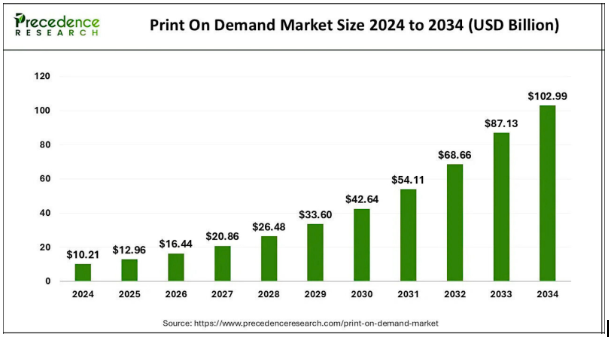
Print-on-demand market size, compound annual growth rate (CAGR) in the past, and the forecast until 2034. Source: Precedence Research
Apparel leads the POD market with a 39.7% share, followed by home decor at 27%. These numbers show strong demand for personalized products. Consumers want custom items that reflect their style, making these categories the most popular for businesses and creators alike.
2. The U.S. print-on-demand market share was valued at $1.89B in 2022
The U.S. print-on-demand market was valued at $1.89 billion in 2022. This is an increase from $1.5 billion in 2021 and $1.3 billion in 2020.
The industry shows strong growth with a compound annual growth rate of 24.4 percent. This aligns closely with the global print-on-demand CAGR of 25.8 percent.
Projections indicate that the market will reach $2.32 billion by the end of 2023. By 2030, it is expected to grow to $10.66 billion.

Source: Grand View Research2
Integration with major e-commerce platforms like Shopify, Etsy, and Amazon has boosted the market. These platforms allow creators and small businesses to sell customized products without keeping inventory.
This trend enables independent artists and entrepreneurs to launch unique merchandise efficiently. It also expands consumer access to personalized products across the country.
3. North America is the largest market for print-on-demand
North America is currently the largest market for print-on-demand (POD). The United States hosts top POD companies like Printful and Zazzle. Other services, such as Redbubble and Gelato, also operate in the region. The U.S. runs 75.8% of the world’s top-performing POD businesses. While North America remains the leader, the Asia Pacific region is expected to grow the fastest, with a projected CAGR of 28% from 2025 to 2034.
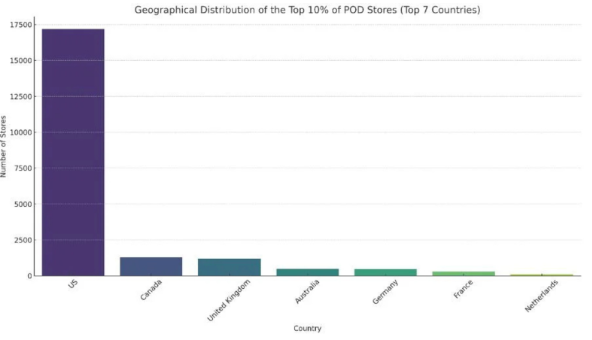
Source: Dropshipping.com
The U.S. POD market was valued at $2.53 billion in 2024. This shows the size and scale of operations in the country. It also highlights why the region attracts both new and established POD businesses looking to expand.
Market growth is strong, with projections reaching $26.95 billion by 2034 at a CAGR of 26.69%. In 2024, the U.S. accounted for 28.3% of global POD revenue, confirming its dominance in the industry.
Learn More: Best Selling Print On Demand Products in 2025
4. The global print-on-demand software market size was $2B in 2022
The global print-on-demand software market was valued at $2 billion in 2022. It is projected to reach $30 billion by 2032, growing at a CAGR of 31.1%. Leading companies in this space include Printful, Printify, Zazzle, Redbubble, and VistaPrint.
Source: Future Market Insights
By platform, the software segment held the largest revenue share in 2024. The service segment is expected to grow the fastest, with a CAGR of 28.7% from 2025 to 2034.
Looking at products, apparel led the market in 2023, making up 37.5% of total sales. Other products are also gaining popularity as demand for customized items increases.
5. The sustainable clothing segment will reach $53.3B in global annual sales by 2032
The global sustainable clothing market was valued at $12.4 billion in 2024 and is projected to reach $53.3 billion by 2032, reflecting a significant upward trend. This growth is driven by increasing consumer awareness and demand for eco-friendly fashion choices.
Notably, men aged 25–44 are becoming the primary demographic for sustainable fashion, with a growing inclination towards purchasing eco-conscious apparel. This shift presents a unique opportunity for brands to tailor their marketing strategies to appeal to this segment.
However, despite the rising interest, 48% of U.S. consumers are unsure where to find sustainable clothing options. This indicates a significant gap in market awareness and presents a valuable opportunity for brands to enhance visibility and accessibility of their sustainable product lines.
6. The print-on-demand software market size will reach $10.7B in the United States by 2032
The U.S. print-on-demand software market is expected to reach $10.7 billion by 2032, with a compound annual growth rate of 30.8%. This rapid growth highlights the strong potential for software companies focused on POD solutions across the country.
Recent projections show the market was valued at $2.50 billion in 2024 and could grow to $14.37 billion by 2032, reflecting a CAGR of 24.43%. This expansion signals significant opportunities for U.S.-based businesses to innovate and capture market share.
Source: Future Market Insights
7. The growing demand for custom products is a vital driver of the POD market
Consumer interest in personalized products is rising quickly. About 81% of shoppers prefer brands that offer unique experiences. Print-on-demand makes it possible to create products on order, even for a single item. This flexibility allows businesses to meet customer demand for one-of-a-kind designs while staying profitable.
The market is growing rapidly. Globally, print-on-demand was valued at $10.2 billion in 2024 and could reach $103 billion by 2034, with a 26% CAGR. In the U.S., it is expected to grow from $2.53 billion to $26.95 billion over the same period.
8. The average monthly search volume for “print-on-demand” is 132.7K searches
Print-on-demand is gaining momentum, with global monthly searches reaching 132,700 and 33,100 from the U.S. alone, the largest market. The industry's growth is evident, with a projected compound annual growth rate (CAGR) of 26% from 2025 to 2034, indicating a steady increase in interest and adoption.

Print-on-demand statistics for print-on-demand companies
Print-on-demand companies are seeing strong growth in 2025, with more entrepreneurs joining the market each year. Understanding key statistics can help you make smarter business decisions. Read the following guides to explore trends, top products, and strategies shaping the industry today.
9. Printful’s revenue reached $289 million in 2021
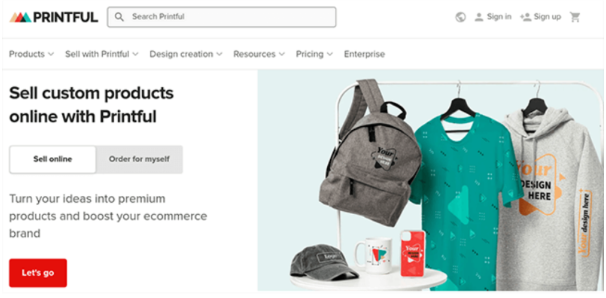
Printful's revenue reached over $289 million in 2021, marking a 39% increase from $208 million in 2020. This growth underscores its position as a leading print-on-demand provider in the U.S.
Source: Printful
The company operates fulfillment centers across the U.S., including locations in Charlotte, North Carolina, and Dallas, Texas. Internationally, Printful has facilities in Toronto, Canada; Tijuana, Mexico; Barcelona, Spain; and Riga, Latvia.
These centers enable Printful to offer efficient and timely fulfillment services to a global customer base. By strategically placing facilities in key regions, the company enhances its ability to meet the demands of diverse markets.
With a robust infrastructure spanning multiple continents, Printful continues to expand its reach, providing print-on-demand solutions to entrepreneurs and businesses worldwide.
10. Printful fulfills over 1 million print-on-demand products for customers every month
Printful has significantly increased its production capacity, fulfilling over 1 million print-on-demand items monthly. By 2022, the company had surpassed 48 million items with a gross merchandise value (GMV) exceeding $1 billion. This growth was bolstered by a $32.4 million investment in printing equipment and technology in 2021.
In 2021, Printful reported a revenue of over $289 million, marking a 39% increase from the previous year. This surge underscores the company's strong position in the print-on-demand market.
To support its expanding operations, Printful opened new fulfillment centers in Dallas, Texas, and the UK. These facilities enhance the company's ability to meet growing demand and improve delivery times.
Source: Printful2, Printful1
11. Gelato’s total revenue exceeded €107 million in 2022
Gelato's total revenue surpassed €107 million in 2022, tripling from the previous year. This growth was fueled by the addition of 34 new production hubs, expanding its network to 130 partners across 32 countries. The company now claims to operate the world's largest on-demand production network for personalized items, serving customers in 184 countries.
Source: Gelato
In 2022, Gelato's revenue from the creator economy more than tripled, significantly contributing to its overall revenue growth. Over 25,000 new e-commerce sellers joined the platform, placing millions of orders that were fulfilled and delivered to end-customers.
By producing locally, Gelato reduces waste, transportation distances, and carbon emissions. In 2022, 87% of orders were produced in the same country as the end customer, enhancing delivery speed and sustainability.
Looking ahead, Gelato plans to expand its network to around 200 production hubs by the end of 2023, aiming for 95% of orders to be fulfilled locally, further strengthening its commitment to sustainability and global reach.
12. Over 85% of Gelato’s orders are produced in the same countries its end customers live in
Gelato operates over 140 production hubs across 32 countries, enabling the company to produce more than 85% of orders within the same country as the end customer. This extensive network allows Gelato to fulfill 90% of orders within five days, minimizing shipping delays and enhancing customer satisfaction.
By producing products only when ordered and as close to the customer as possible, Gelato ensures that 99% of products are produced and delivered within the same region, significantly reducing carbon emissions and transportation costs.
Looking ahead, Gelato plans to expand its network to 200 production hubs by the end of 2023, aiming to fulfill 95% of orders locally. This expansion will further enhance the company's ability to meet global demand efficiently while maintaining its commitment to sustainability
Source: Gelato
13. Printify closed a $50M Series A funding round in November of 2021
In November 2021, Printify secured a $50 million Series A funding round, led by Index Ventures. The round included over 40 investors, such as H&M Group, Virgin Group, and Squarespace. This significant investment aimed to bolster Printify's global expansion and technological advancements.
Source: Printify1
A portion of the funds, $10 million, was allocated to employees who sold their shares, enhancing their compensation and aligning their interests with the company's success. The remaining capital was directed towards scaling operations and enhancing the platform's capabilities.
By 2025, Printify's user base had grown to 10 million active users. This milestone underscores the increasing demand for print-on-demand services among entrepreneurs and creators seeking to launch custom products without upfront inventory costs.
14. Shopify hosts 62.8% of the POD and dropshipping stores
Shopify hosts 62.8% of all print-on-demand and dropshipping stores, making it the top choice for POD businesses. Its easy-to-use store builder and seamless integrations with major POD suppliers help sellers set up and run stores efficiently. Choosing the right platform can influence a store’s success, so while Shopify dominates, exploring other platforms can still be useful.
The print-on-demand market is growing fast, with a projected value of $8.16 billion in 2025 and $19.8 billion by 2029. Apparel leads the market with 37% share, followed by home decor at 27%, showing where most demand lies.
Today, Printify operates over 110 printing locations worldwide, delivering products to a diverse clientele. The company's commitment to innovation and user satisfaction continues to drive its expansion in the global e-commerce landscape.
Print-on-demand statistics for businesses
The print-on-demand industry is growing quickly, offering new opportunities for businesses of all sizes. Understanding key statistics can help you make smarter decisions and spot trends early. Keep reading the following guides to learn how these numbers can shape your business strategy.
15. Most mid to high-volume print-on-demand merchants maintain profit margins between 40 and 45%
Most mid- to high-volume print-on-demand merchants keep profit margins between 40% and 45%. This means they earn about $4 to $5 on every $10 product they sell.
Merchants set their prices higher than the cost of the products from POD providers like Printify. The extra money becomes their profit.
For example, a t-shirt that costs $15 from the POD provider might sell for $21. That leaves around $6 in profit for the merchant on each sale.
POD allows sellers to avoid inventory problems. They don’t need to buy products upfront or store them in a warehouse.
They also don’t handle shipping. The POD service prints and ships each order directly to the customer. This makes running a POD business simpler and less risky.
Profit margins vary by product type. Apparel usually averages around 40%. Mugs, journals, and other items can reach up to 70% profit.
The average monthly income for a POD merchant ranges from $4,639 to $9,833. This depends on how many products they sell and the profit margin for each.
Still, not all POD stores last. About 24% of POD shops remain active after three years. Planning, marketing, and choosing the right products are key to long-term success.
Source: Printify2
16. Most print-on-demand merchants sell to eight to 16 countries
Most print-on-demand merchants sell internationally, reaching between 8 and 16 countries. Printify’s data shows mid-volume sellers typically reach 8 countries, while high-volume merchants expand to 16. Global fulfillment networks make it easy to serve customers worldwide without managing shipping directly.
The global print-on-demand market was valued at $8.93 billion in 2024 and is expected to grow to $57.49 billion by 2033, with a CAGR of 23.3%. This growth highlights the increasing opportunity for merchants to reach international customers and scale their businesses.
Source: Printify2
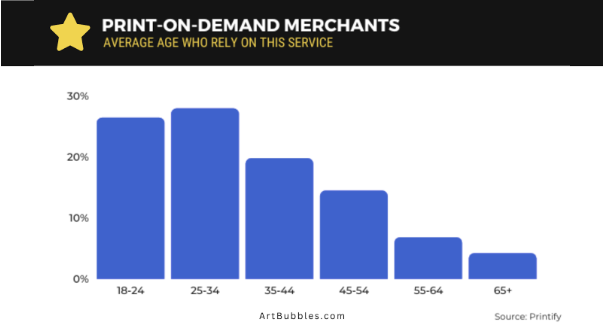
17. The average age range of merchants who rely on print-on-demand services is 18-35
Most print-on-demand merchants are between 18 and 35 years old, though the age range extends from 18 to over 65. This shows that POD attracts younger entrepreneurs seeking flexible, low-risk business opportunities, while still offering older individuals a way to earn side income or explore creative projects.
Source: Printify2
About 24% of POD stores remain active after three years. This highlights the need for persistence and adaptability to succeed in this growing industry.
18. The average business success rate with print-on-demand is 24%
The average business success rate with print-on-demand sits at 24% according to Dropshipping.com. It is easy to start, attracting both beginners and pros, but this low barrier creates fierce competition. Long-term success belongs to those who find a unique niche, create high-quality designs, and market their products well.
Shopify dominates the POD platform market, with about 62.8% of POD and dropshipping stores operating on it. Choosing the right platform and focusing on quality and promotion can make a big difference in standing out.
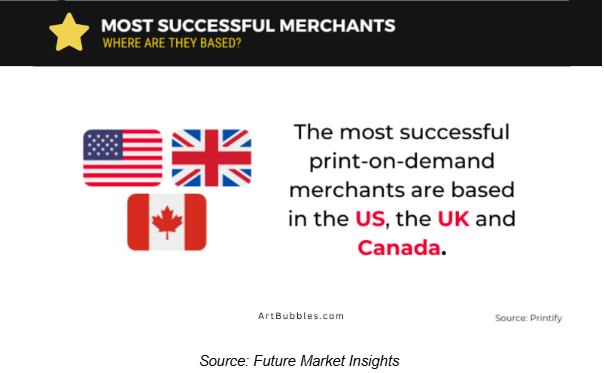
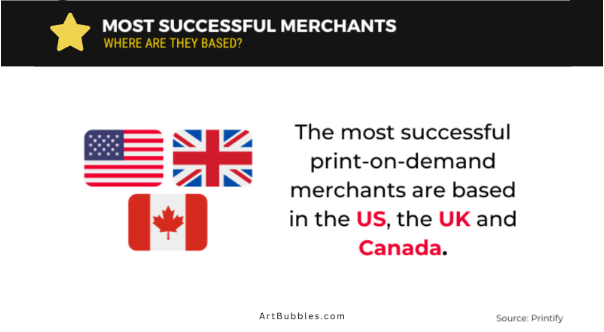
19. The most successful print-on-demand merchants are based in the US, the UK and Canada
The most successful print-on-demand merchants are mainly in the United States, United Kingdom, and Canada. Australia, Germany, Vietnam, Turkey, and the Netherlands also have growing POD businesses. In the US, states like California, Ohio, Texas, Florida, Georgia, New York, Virginia, and Illinois show the highest activity. Being near large markets, suppliers, and shipping hubs can help merchants grow faster and reach more customers.
Europe is another strong market for POD. The European POD market could grow from $1.58 billion in 2024 to $12.09 billion by 2032. The UK and Germany lead this growth, with more merchants offering customized products.
Asia-Pacific is growing even faster. This region has a projected growth rate of 27.5% as more people shop online and discover POD options. Merchants in countries like Vietnam and Australia are expanding quickly to meet this demand.
Asia-Pacific is growing even faster. This region has a projected growth rate of 27.5% as more people shop online and discover POD options. Merchants in countries like Vietnam and Australia are expanding quickly to meet this demand.
Source: Printify2
Location impacts success in POD because it affects shipping speed, production costs, and customer access. Merchants near major markets often get more sales and can offer faster delivery, giving them an advantage over others.
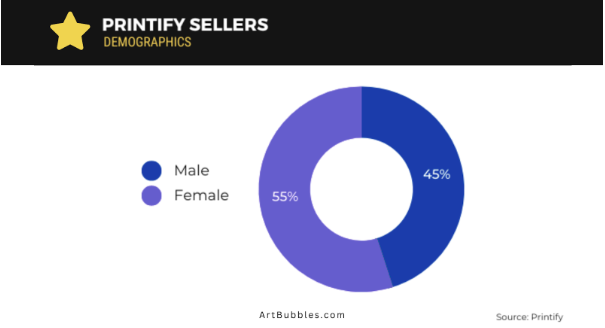
20. 55% of print-on-demand merchants are female
According to Printify’s data, 55% of print-on-demand merchants are female, while 45% are male. This near-even split shows that both men and women are actively shaping the POD industry and taking advantage of its opportunities.
Source: Printify2
Around 24% of POD stores stay active after three years. This highlights that persistence and smart strategies play a key role in long-term success for merchants.
21: Promotional products made $26.7B in sales last year
Promotional products generated $26.7 billion in sales last year, showing the strength of this market in print-on-demand. Clothing led the way with 26.6% of sales. Drinkware made up 10.2%, hats 7.9%, and bags and travel accessories 7%, offering brands plenty of options to connect with their audience.
The industry continues to grow, reaching $26.6 billion in 2024, a 1.8% increase from the year before. Experts expect sales to hit $27.8 billion in 2025, showing strong potential for businesses to expand in this niche.
22. Direct-to-garment printing (DTG) is growing at 4.4% CAGR
Direct-to-garment (DTG) printing is a popular method in the print-on-demand industry. It is growing steadily at a 4.4% CAGR and is projected to reach $1.34 billion by 2035. While DTG remains widely used, sublimation printing is expanding even faster at a 10.44% CAGR.
Sublimation printing is seeing strong demand across garments, household items, and technical textiles. Its market is expected to reach $11.8 billion by 2025, driven by businesses seeking vibrant, durable, and versatile printing solutions.

General ecommerce statistics
Ecommerce continues to grow steadily, with more people shopping online each year. Sales numbers are rising across categories, making online retail a major part of the global economy. Keep reading to explore the following guides for key insights and data you need for 2025.
23. Revenue generated by global ecommerce sales will reach $4T by 2024
Global eCommerce sales are set to reach $4 trillion by 2024. This growth reflects the rising adoption of online shopping across the world. The market continues to expand, with Asia leading the way in revenue generation.
The Americas and Europe follow, showing steady increases in online retail sales. Smaller markets like Australia, Oceania, and Africa are growing at a slower pace but still contribute to global totals.
New trends are shaping the future of online commerce. Social commerce is booming on platforms like Instagram, TikTok, and Pinterest, with revenue expected to reach $6.2 trillion by 2030. Voice commerce is also rising as AI improves shopping experiences.
- Asia: $2.06 trillion
- North & South Americas: $1.1 trillion
- Europe: $722 billion
- Australia & Oceania: $49 billion
- Africa: $40.2 billion
Source: Statista1
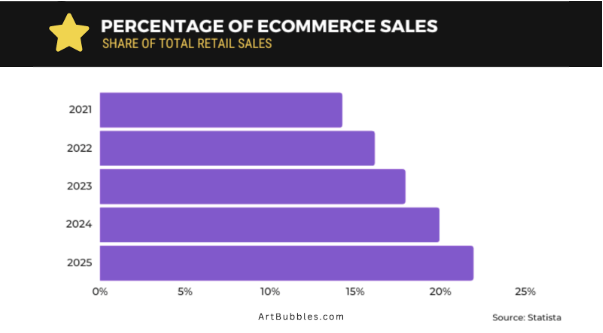
24. Ecommerce sales will make up 21.9% of all retail sales by 2025
Ecommerce sales accounted for 14.2% of all retail sales in 2021. This shows how online shopping has become a larger part of consumer habits.
Over the next few years, this share is expected to rise steadily.
By 2025, ecommerce is projected to make up 21.9% of total retail sales, reflecting consistent growth.
Source: Statista
If you want, I can also make 2-3 alternative versions with slightly varied phrasing.
25. Retail ecommerce sales are expected to grow at a CAGR of 11.34% globally
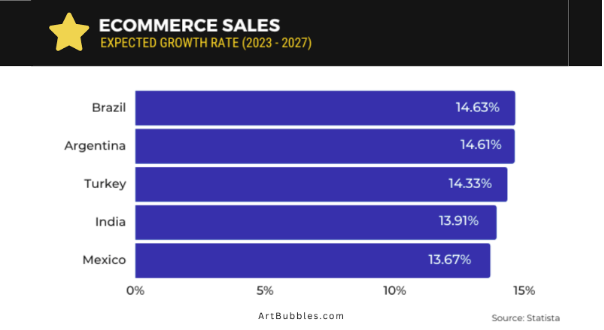
Retail eCommerce sales are growing steadily worldwide, with a projected global CAGR of 11.34% from 2023 to 2027. This growth reflects increasing online shopping adoption and evolving consumer habits.
Source: Statista
Some regions are leading this surge, showing the fastest growth rates:
- Brazil – 14.63%
- Argentina – 14.61%
- Turkey – 14.33%
- India – 13.91%
- Mexico – 13.67%
Electronics, fashion, and groceries are the fastest-growing online product categories, driving much of this expansion and shaping the future of global eCommerce.
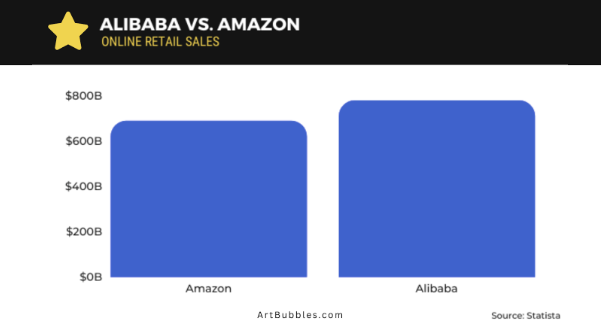
26. Alibaba Group is the world’s leading online retailer with annual sales totalling $780B
Alibaba Group leads the global ecommerce market, generating $780 billion in annual sales. It operates AliExpress, a top dropshipping platform that fulfills orders as they come in.
Dropshipping services like AliExpress are closely linked to the print-on-demand industry. They help businesses ship products directly to customers without holding inventory.
Amazon ranks second, with $690 billion in revenue. Analysts expect it to surpass Alibaba by 2027, reaching $1.2 trillion in annual sales.
Both companies invest heavily in technology. AI, automated warehouses, and advanced logistics systems support faster, accurate order fulfillment.
Source: Statista
These strategies strengthen their global reach and influence ecommerce trends worldwide, shaping how online retail and POD services grow.
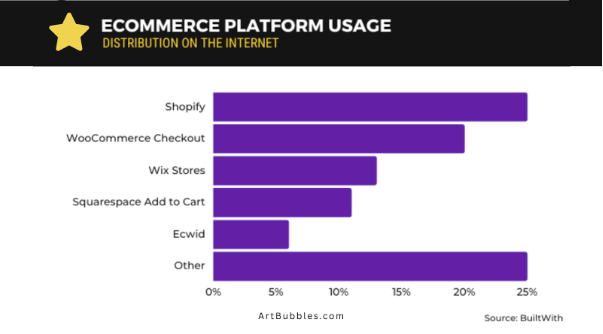
27. 25% of all ecommerce stores use Shopify
Shopify powers 25% of all online stores, showing its strong presence in ecommerce. Its reach extends to 19% of the top 10,000 websites, proving that leading businesses trust the platform.
Source: BuiltWith
The platform integrates seamlessly with most print-on-demand services. Merchants can build stores on Shopify while letting POD services handle order fulfillment efficiently.
Shopify has grown steadily over the years, with more stores joining each year. This growth highlights its popularity and the advantages it offers to businesses of all sizes.
28. More than 17% of all global retail sales in 2024 happened online
Over 17% of all retail sales happened online in 2024. This figure is expected to rise to 21% by 2029. The global ecommerce market is expanding rapidly, showing the strong shift toward digital shopping.
For print-on-demand merchants, this growth creates new opportunities. More shoppers are looking for unique and personalized products that stand out from mass-produced items.
Subscription boxes and repeat-order services are also on the rise. These trends give POD businesses a chance to earn steady revenue while building long-term customer relationships.
General statistics from around the printing industry
The printing industry continues to show steady growth across multiple sectors, from commercial printing to 3D and print-on-demand products. These numbers highlight opportunities for businesses and creators alike. Keep reading the following guides to explore key statistics and trends shaping the industry in 2025.
29. The automotive 3D printing market size is expected to grow to $15.8B by 2032
The global automotive 3D printing market is expected to reach $15.8 billion by 2032, growing at a CAGR of 22.4%. This growth is driven by its main uses in prototyping, research and development, and production.
On-demand 3D printing helps optimize supply chains. Companies can reduce inventory costs and shorten lead times.
Adopting 3D printing gives businesses more flexibility in design and manufacturing. It allows them to stay ahead in the automotive market.
Source: Market.Us
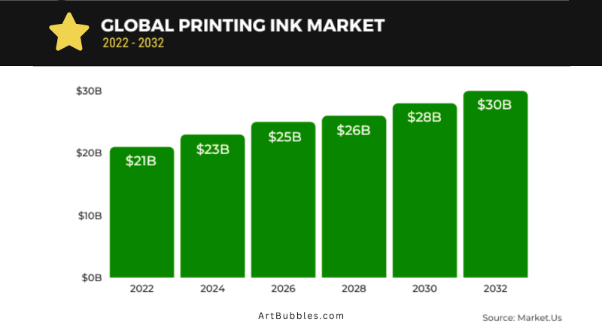
30. The global printing ink market was valued at $21.2 billion in 2022
The global printing ink market was valued at $21.2 billion in 2022. It is expected to reach around $30 billion by 2032, growing at a CAGR of 3.8%.
Printing inks are mainly used in gravure, flexographic, lithographic, and digital printing. These methods cover most industrial and commercial printing needs.
Source: Market.Us
Eco-friendly inks are becoming more popular. Bio-based and UV-curable inks are in demand due to environmental rules and the push for sustainable packaging.
31. The A4 laser printer market size was $2.02 billion in 2022
The A4 laser printer market was valued at $2.02 billion in 2022 and is projected to reach $9.2 billion, growing at a CAGR of 16.4%. This growth highlights its rising importance in the printing industry.
Single-function printers are preferred for high-volume tasks. Multi-function printers are becoming popular for scanning, copying, and faxing.
A4 laser printers are widely used in small offices, home offices, schools, and government offices. They offer secure and efficient printing solutions for various users.
Source: Market.Us
32. The commercial printing market size will be worth $469.8 billion in 2023
The commercial printing market is projected to reach $469.8 billion in 2023 and grow to $586.2 billion by 2032, with a CAGR of 2.3%. Common printing methods include lithographic, digital, screen, gravure, and flexographic printing.
The packaging sector is driving growth, with annual increases of 9% to 11% globally and up to 15% in India, fueled by e-commerce and branding needs.
At the same time, traditional print methods are declining by 5% globally, while digital printing continues to gain momentum across industries.
Source: Market.Us
33. The 3D printing plastic industry will have a market size of $6.8 billion by 2032
The 3D printing plastic industry is expanding rapidly. Its market size is expected to grow from $797 million to $6.8 billion by 2032, reflecting a CAGR of 24.6%. Strong demand from multiple sectors is driving this growth.
Key plastic types like PLA, ABS, and PETG are leading the market. These materials are popular for their durability, ease of use, and versatility in different applications.
Industries such as healthcare, automotive, and consumer goods are adopting these plastics quickly. The combination of material innovation and sector demand continues to push the market forward.
Source: Market.Us
Print-on-demand trends
Print-on-demand is growing rapidly in 2025, with new trends shaping how businesses and creators sell products. From popular product types to design and sustainability shifts, the industry is evolving quickly. Keep reading the following guides to learn the key statistics and trends that can help you stay ahead.
34. The top trending print-on-demand categories are apparel, home decor, drinkware, and accessories
Apparel remains the leading print-on-demand category. Sellers can quickly follow fashion trends by offering custom designs, patterns, and colors. On-demand production lets them start selling without large upfront costs, making it easier to match what customers want.
Home decor is growing fast, with a 28% CAGR. Many people want personalized indoor spaces, which makes POD an attractive alternative to DIY projects. Custom wall art, pillows, and decor items allow sellers to meet this demand and capture a growing market.
Drinkware, including tumblers and travel mugs, also benefits from POD. Familiar shapes let sellers add unique designs while appealing to a wide audience. Accessories like bags, hats, and phone cases continue to gain popularity, offering more options for personalization and creative expression.
Design trends in 2025 show what customers prefer. Popular styles include funny artwork, minimalism, typography, vintage, retro, black and white, doodles, and pastel tones. Using these styles helps sellers create products that stand out and stay on trend.
35. The top trending apparel print-on-demand products are t-shirts, sportswear, and leggings
T-shirts remain the most popular product in print-on-demand apparel. They were the starting point for many POD suppliers and continue to attract buyers with simple, versatile designs.
Sportswear and leggings are also top sellers. Their comfort and practicality make them a favorite for everyday wear, while custom hoodies add a personal touch that shoppers enjoy.
Denim jackets are gaining interest, showing that customers are willing to pay more for premium items. This rise in popularity opens opportunities for higher profit margins in the POD market.
Sustainability is shaping trends as well. Eco-friendly fabrics, such as organic cotton and recycled polyester, are drawing attention from shoppers who want stylish and responsible clothing choices.
That’s it for print-on-demand statistics 2025 - now what?
The print-on-demand industry is growing fast. Consumer interest in personalized products is higher than ever. Businesses that tap into this demand can reach more customers and increase sales. Automation and AI-driven design tools are making it easier to create, test, and scale products.
These trends give you a strong starting point. You now have the data to refine your strategies and focus on what matters most. By understanding consumer behavior and market trends, you can make smarter decisions for your store.
To make the most of these insights, try these actions:
- Update your product catalog with top items like apparel, home decor, and drinkware
- Add new products every month to keep your store fresh
- Monitor consumer preferences and replace low-performing designs
- Check profit margins and aim for at least 20%
- Refresh marketing visuals and messaging for better engagement
- Align your brand with sustainability efforts
Small changes can lead to big results. Regularly reviewing products and marketing strategies helps you stay competitive. These actions also make it easier to respond to trends quickly.
Use this information as a guide to experiment and test new ideas. Adjust your offerings, designs, and marketing to see what works best.
Your print-on-demand business has the chance to grow and thrive in 2025. Keep iterating, learning, and improving. With the right approach, you can meet high demand and create a responsive, successful store.